Modules DLx are Linear (and Rotary) Variable Differential Transformer (D/L( R )VDT) Simulation Modules. L( R )VDT are transformer-type
voltage/current transducers that convert a linear/rotary movement of a core/shaft to a multi-wire differential AC electrical signal. Both deliver
signals linearly proportional to the position of the shaft (magnetic induction core). A LVDT/RVDT simulator is used to convert digital positional
commands to corresponding AC signals.
A wide variety of DLx modules are available to cover the range of excitation (noted in this manual as ‘reference’) voltages/frequency, include
extensive field-parameter programmability, and provide a full operating envelope choice for simulating virtually any type of LVDT or RVDT. By
eliminating the need for external transformers and operating with lower AC reference frequencies, these solid-state designs offer huge space
savings.
For a brief description of the modules and complete list of specifications, click here for the DLx data sheet.
See Model Designations table below for a description of the available DLx configurations.
Module IDLinear
No. of Channels
Full Scale Output Voltage (RMS VL-L)
Output Load
Frequency Range (Hz)
DL1
1*
2-28
3 VA @ 28 VRMS
47-1k
DL2
1*
2-28
3 VA @ 28 VRMS
1k-5k
DL3
1*
2-28
3 VA @ 28 VRMS
5k-10k
DL4
1*
2-28
3 VA @ 28 VRMS
10k-20k
DL5
1*
28-90
3 VA @ 90 VRMS
47-1k
DLA
2
2-28
1.5 VA @ 28 VRMS
47-1k
DLB
2
2-28
1.5 VA @ 28 VRMS
1k-5k
DLC
2
2-28
1.5 VA @ 28 VRMS
5k-10k
DLD
2
2-28
1.5 VA @ 28 VRMS
10k-20k
DLE
2
28-90
2.2 VA @ 90RMS
V 47-1k
DLJ
3
2-28
0.5 VA @ 28 VRMS
47-1k
DLK
3
2-28
0.5 VA @ 28 VRMS
1k-5k
DLL
3
2-28
0.5 VA @ 28 VRMS
5k-10k
DLM
3
2-28
0.5 VA @ 28 VRMS
10k-20k
DLN
3
28-90
0.5 VA @ 90 VRMS
47-1k
There are three types of D/L modules:
3-Channel Modules: These high-density modules have a lower power output drive (0.5 VA per channel, maximum). The lower power
output drive is ideal for driving solid-state input instruments, gauges (most LVDT/RVDT measurement circuits are high input impedance,
as “real” LVDTs/RVDTs do not supply a large amount of current).
2-Channel Modules: The 2-channel modules have a standard power output drive of 1.5 VA (2.2 VA for DLE) per channel, maximum.
Single-Channel Modules: The single-channel modules have a high-power output drive capability (3 VA per channel, maximum).
* Contact factory for single channel availability
PRINCIPLE OF OPERATION
The Digital-to-LVDT/RVDT (DLV) Simulation Module provides up to three channels of individual two/three/four-wire “programmable” outputs. It is
designed for wide field-programmability of both excitation (reference) and output signal voltage.
The DLx allows the user to program the module for either ratio or fixed output mode. When set to ratio mode, each channel utilizes a
transformation ratio (TR) which sets the maximum output signal voltage in relation to the input reference voltage (TR = Max Output
Voltage/Reference Voltage). This ratiometric design eliminates errors caused by variations in reference voltage by allowing the output voltage to
adjust with it. When set to fixed mode, the output voltage is absolute and does not change with reference voltage variations.
The DLx also features a wrap-around self-test for measuring the output position, current and carrier frequency of each channel.
Programmable Output Format
The output format can be programmed to simulate two-wire or three/four-wire LVDTs. Each channel features its own isolated ‘A’ and ‘B’ high/low
line output pair. An independent reference input voltage is supplied to each ‘A’ and ‘B’ output pair.
When set to four-wire mode, the module has one commanded position that sets the voltage levels of each output pair. For example, setting the
position to 0% will make both the ‘A’ and ‘B’ pair outputs the same output voltage. If the position is set to 100%, the ‘A’ output will be the maximum
output voltage while the ‘B’ output will be 0 VL-L.
When set to three-wire mode, the ‘A’ and ‘B’ low lines are paired at the external load. This will give the channel a common low line, one ‘A’ high
line and one ‘B’ high line. If the commanded position is set to 100%, the ‘A’ high line will be the maximum output voltage while the ‘B’ high line will
be 0 VL-L.
When set to two-wire mode, the channel is split into independent position control. Each output (‘A’ and ‘B’) will have its own commanded position.
Voltage Feedback Sense Lines
The DLx Simulation Module includes two voltage feedback sense lines for each output channel A/B pair. They provide automatic output drive
voltage compensation during higher current applications that may induce voltage drops in the wiring. They also provide compensation for lower
voltage applications (which are more susceptible to voltage drops).
It is always recommended that the sense lines be utilized and connected at the external load to provide maximum measurement accuracy (which
ensures that the commanded voltage is applied at the load). Sense (Hi) should be connected to Output (Hi), and Sense (Lo) should be connected
to Output (Lo). If additional wiring is prohibitive in the application, the sense lines may instead be terminated at the connector (note: accuracy will
not be as good as “remote sensing” at the load).
Built-In Test (BIT)/Diagnostic Capability
The board supports three types of built-in tests: Power-On, Continuous Background and Initiated. The results of these tests are logically ORed
together and stored in the BIT Dynamic Status and BIT Latched Status registers.
Power-On Self-Test (POST)/Power-on BIT/Start-up BIT (SBIT)
This board features a power-on self-test that will do an accuracy check of each channel and report the results in the BIT Status register when
complete. After power-on, the Power-on BIT Complete register should be checked to ensure that POST/PBIT/SBIT test is complete before
reading the BIT Latched Status.
Continuous Background Built-In Test
The background Built-In-Test or Continuous BIT (CBIT) (“D2”) runs in the background where each channel is checked to a test accuracy of 0.2%
FS. The testing is totally transparent to the user, requires no external programming, and has no effect on the operation of the module or card.
The technique used by the continuous background BIT (CBIT) test consists of an “add-2, subtract-1” counting scheme. The BIT counter is
incremented by 2 when a BIT-fault is detected and decremented by 1 when there is no BIT fault detected and the BIT counter is greater than 0.
When the BIT counter exceeds the (programmed) Background BIT Threshold value, the specific channel’s fault bit in the BIT status register will
be set. Note, the interval at which BIT is performed is dependent and differs between module types. Rather than specifying the BIT Threshold as
a “count”, the BIT Threshold is specified as a time in milliseconds. The module will convert the time specified to the BIT Threshold “count” based
on the BIT interval for that module. The “add-2, subtract-1” counting scheme effectively filters momentary or intermittent anomalies by allowing
them to “come and go“ before a BIT fault status or indication is flagged (e.g. BIT faults would register when sustained; i.e. at a ten second interval,
not a 10-millisecond interval). This prevents spurious faults from registering valid such as those caused by EMI and/or dirty power causing false
BIT faults. Putting more “weight” on errors (“add-2”) and less “weight” on subsequent passing results (subtract-1) will result in a BIT failure
indication even if a channel “oscillates” between a pass and a fail state.
Initiate Built-In Test
The DLx module supports an off-line Initiated Built-In Test (IBIT) (“D3”).
IBIT test starts an initiated BIT test that utilizes an internal stimulus to generate and test the full-scale positional range to a default test accuracy of
0.1% full scale range. IBIT test cycle is completed within 30 seconds and the result can be read from the BIT status registers when IBIT bit
changes from 1 to 0.
Status and Interrupts
The DLx Simulation Module provide registers that indicate faults or events. Refer to “Status and Interrupts Module Manual” for the Principle of
Operation description.
Module Common Registers
The DLx Simulation Module includes module common registers that provide access to module-level bare metal/FPGA revisions & compile times, unique serial number information, and temperature monitoring. Refer to “Module Common Registers Module Manual” for the detailed information.
REGISTER DESCRIPTIONS
The register descriptions provide the register name, Type, Data Range, Read or Write information, Initialized Value, a description of the function
and, in most cases, a data table.
Control Registers
Power On/Off
Function:
Turns on the selected channel and initiates output.
Type:
unsigned binary word (32-bit)
Data Range:
0x0000 0000 - 0x0000 0007 (for supporting up to 3 channels)
Read/Write:
R/W
Initialized Value:
0x0000 0000
Operational Settings:
To turn on the selected channel, set the bit to 1.
D31
D30
D29
D28
D27
D26
D25
D24
D23
D22
D21
D20
D19
D18
D17
D16
0
0
0
0
0
0
0
0
0
0
0
0
0
0
0
0
D15
D14
D13
D12
D11
D10
D9
D8
D7
D6
D5
D4
D3
D2
D1
D0
0
0
0
0
0
0
0
0
0
0
0
0
0
Ch3
Ch2
Ch1
Output Format
Function:
Select between two-wire or three/four-wire mode.
Type:
unsigned binary word (32-bit)
Range:
1 or 2
Read/Write:
R/W
Initialized Value:
1 (three/four wire)
Operational Settings:
Sets the output format of the DLV channel. Set register to a 0x1 for three/four wire mode or a 0x2 for two wire mode.
Set Position A/B
Function:
Sets position of each channel.
Type:
unsigned binary word (32-bit)
Range:
-100% to +99.999%
Read/Write:
R/W
Initialized Value:
0%
Operational Settings:
Write a 32-bit integer to the corresponding channel DLV Position Register. Even though the output resolution is 16 bits, the position setting is up to 24 bits and written into a 32-bit register. WORD = Position / (200/ 2^32) LSB is 200/2 or approximately 0.000000046566%. The upper 24 bits define the position, while the lower 8 bits are at zero. Example 1: For a position of 78.125 WORD = 78.125 / (200 / 2^32) = 0x6400_0000 Example 2: For a position of -78.125 WORD = -78.125 / (200 / 2^32) = 0x9C00_0000
D31
D30
D29
D28
D27
D26
D25
D24
D23
D22
D21
D20
D19
D18
D17
D16
100
50
25
12.5
6.25
3.125
1.5625
0.78125
0.39063
0.19531
0.09766
0.04883
0.02441
0.01221
0.00610
0.00305
D15
D14
D13
D12
D11
D10
D9
D8
D7
D6
D5
D4
D3
D2
D1
D0
.00153
.00076
.00038
.00019
.000095
.000048
.000023
.000012
0
0
0
0
0
0
0
0
Set Voltage
Function:
Sets signal voltage “VL-L” to a corresponding register.
Type:
unsigned binary word (32-bit)
Range:
2-28 or 28-90 VL-L depending on model
Read/Write:
R/W
Initialized Value: 2
8 VL-L for low voltage modules and 90 VL-L for high voltage modules.
Operational Settings:
The output voltage is set with a resolution of 10 mV . The setting is in integer decimal format. For example, if channel 1 Signal (VL-L) voltage is to be 11.8 V , the set word to the corresponding register would be 1180.
Expected Reference
Function:
Sets reference voltage “V ” to a corresponding register.
Type:
unsigned binary word (32-bit) Range: 2-115 V Read/Write: R/W
Initialized Value:
26 or 115 V depending on model
Operational Settings:
The input voltage is set with a resolution of 10 mV. The setting is in integer decimal format. For example, if channel 1 expected input REF voltage is 26.0 V , the set word to the corresponding register would be 2600.
Set Phase Offset
Function:
Enables setting the phase (in degrees) of each channel to an offset of the Reference.
Type:
unsigned binary word (32-bit) Range: +/- 90° Read/Write: R/W
Initialized Value:
0°
Operational Settings:
The phase offset has 24-bit resolution put into the MSBs of the 32-bit word. Word = Phase / (360/2 )
D31
D30
D29
D28
D27
D26
D25
D24
D23
D22
D21
D20
D19
D18
D17
D16
180
90
45
22.5
11.25
5.625
2.813
1.406
.703
.352
.176
.088
.044
.022
.011
.0055
D15
D14
D13
D12
D11
D10
D9
D8
D7
D6
D5
D4
D3
D2
D1
D1
.00274
.00137
.00068
.00034
.00017
.00008
.00004
.00002
0
0
0
0
0
0
0
0
Output Mode (Ratio/Fixed)
Function:
Enables selection of either ratiometric (ratio) or absolute (fixed) mode output voltages.
Type:
unsigned binary word (32-bit)
Range:
0 or 1 (per channel; model dependent)
Read/Write:
R/W
Initialized Value:
Ratiometric
Operational Settings:
Ratiometric Mode, when selected, will cause the output signal voltage of the channel to vary with the input Reference Voltage. Fixed Mode, when selected, will cause the output signal voltage of the channel NOT to vary with the input Reference Voltage. Set corresponding channel bit to 0 for Ratiometric Mode. Set corresponding channel bit to 1 for Fixed Mode.
D31
D30
D29
D28
D27
D26
D25
D24
D23
D22
D21
D20
D19
D18
D17
D16
0
0
0
0
0
0
0
0
0
0
0
0
0
0
0
0
D15
D14
D13
D12
D11
D10
D9
D8
D7
D6
D5
D4
D3
D2
D1
D0
0
0
0
0
0
0
0
0
0
0
0
0
0
0
0
D
Measurement Registers
Measured Position A/B
Function:
Measures each channel's position.
Type:
unsigned binary word (32-bit)
Range:
+/-100%
Read/Write:
R
Initialized Value:
0%
Operational Settings:
Measured position in percent = register value* (200/2 ).
D31
D30
D29
D28
D27
D26
D25
D24
D23
D22
D21
D20
D19
D18
D17
D16
-100
50
25
12.5
6.25
3.125
1.5625
0.78125
0.39063
0.19531
0.09766
0.04883
0.02441
0.01221
0.00610
0.00305
D15
D14
D13
D12
D11
D10
D9
D8
D7
D6
D5
D4
D3
D2
D1
D0
.00153
.00076
.00038
.00019
.000095
.000048
.000023
.000012
0
0
0
0
0
0
0
0
Measured Frequency
Function:
Reads each channel's input reference frequency.
Type:
unsigned binary word (32-bit)
Range:
Depends on model
Read/Write:
R
Initialized Value:
0 Hz
Operational Settings:
The input reference frequency is reported to a resolution of 1 Hz. The output is in integer decimal format. For example, if channel 1 input excitation is 400 Hz, the output measurement word from the corresponding register would be 400.
Measured Signal Voltage A/B
Function:
Reads each channel's output signal voltage (VL-L).
Type:
unsigned binary word (32-bit)
Range:
2-28 or 28-90 VL-L depending on model
Read/Write:
R
Initialized Value:
0 VLL on power up Operational Settings: The output voltage is reported to a resolution of 10 mVRMS. The output is in integer decimal format. For example, if channel 1 output signal voltage is 11.8 VRMS, the output measurement word from the corresponding register would be 1180.
Measured Reference Voltage
Function:
Reads each channel's input signal reference voltage (VREF ).
Type:
unsigned binary word (32-bit)
Range:
2-115 VREF
Read/Write:
R
Initialized Value:
0 VREF on power up
Operational Settings:
The input voltage is reported to a resolution of 10 mVREF. The output is in integer decimal format. For example, if channel 1 input V voltage is 26.0 VREF, the output measurement word from the corresponding register would be 2600.
Measured Current A/B
Function:
Displays the measured current on the channel's output.
Type:
unsigned binary word (32-bit)
Range:
NA
Read/Write:
R
Initialized Value:
0
Operational Settings:
Measures current in milliamps.
Threshold Programming Registers
The Signal Loss Threshold A/B and Reference Loss Threshold registers set the
threshold limits to the Signal Loss Status and Reference Loss Status
registers respectively.
Signal Loss Threshold A/B
Function:
Programmable status threshold to indicate when the measured VLL falls below this value.
Type:
unsigned binary word (32-bit)
Range:
10mVL-L up to 90 VL-L
Read/Write:
R/W
Initialized Value:
80% of default output voltage.
Operational Settings:
The signal loss detection circuitry can be tailored to report a signal loss (at Signal Loss Status register) at a user defined threshold. This threshold can be set to a resolution of 10 mVL-L. Program the threshold by writing the value of the voltage threshold in integer decimal format. For example, if Channel 1 signal loss voltage threshold is to be 7 VL-L, the programmed word to the corresponding register would be 700 (2BCh).
Reference Loss Threshold
Function:
Programmable status threshold to indicate when the measured VREF falls below this value.
Type:
unsigned binary word (32-bit) Range: 10m Vrms up to 115 Vrms
Read/Write:
R/W
Initialized Value:
80% of the default expected reference
Operational Settings:
The reference loss detection circuitry can be tailored to report a reference loss at a user defined threshold. This threshold can be set to a resolution of 10 mVrms. Program the threshold by writing the value of the voltage threshold in integer decimal format. For example, if channel 1 input reference loss voltage threshold is to be 20 Vrms, the programmed word to the corresponding register would be 2000 (7D0h).
Test Registers
Two different tests, one on-line (CBIT) and one off-line (IBIT), can be
selected. External reference voltage is not required for any of these tests.
Test Enabled
Function:
Set bit in this register to enable associated Built-In Self-Test IBIT and CBIT.
Type:
unsigned binary word (32-bit)
Data Range:
0x0000 to 0x000D
Read/Write:
R/W
Initialized Value:
0x4 (CBIT Test Enabled)
Operational Settings:
BIT tests include an on-line (CBIT) test and an off-line (IBIT) test. Failures in the BIT tests are reflected in the BIT Status registers for the corresponding channels that fail. In addition, an interrupt (if enabled in the BIT Interrupt Enable register) can be triggered when the BIT testing detects a failure.
D31
D30
D29
D28
D27
D26
D25
D24
D23
D22
D21
D20
D19
D18
D17
D16
0
0
0
0
0
0
0
0
0
0
0
0
0
0
0
0
D15
D14
D13
D12
D11
D10
D9
D8
D7
D6
D5
D4
D3
D2
D1
D0
0
0
0
0
0
0
0
0
0
0
0
0
IBIT Test D
CBIT Test 1
0
0
Test CBIT Verify
Function:
Allows user to verify if the CBIT test is running.
Type:
unsigned binary word (32-bit)
Data Range:
0x0000 0000 to 0xFFFF FFFF
Read/Write:
R/W
Initialized Value:
0
Operational Settings:
User can write any value to this register. If CBIT test is running, after a minimum of 10ms the value read back will be 0x0000 0055, otherwise the value read back will be the value written.
Module Common Registers
Refer to “Module Common Registers Module Manual” for the register descriptions.
Status and Interrupt Registers
The DLx Module provides status registers for BIT, Signal Loss, Reference
Loss, Phase Lock and Overcurrent.
Channel Status Enabled
Function:
Determines whether to update the status for the channels. The feature can be used to “mask' status bits of unused channels in status registers that are bitmapped by channel.
Type:
unsigned binary word (32-bit)
Data Range:
0x0000 0000 - 0x0000 FFFF
Read/Write:
R/W
Initialized Value:
0x0000 FFFF
Operational Settings:
When the bit corresponding to a given channel in the Channel Status Enabled register is not enabled (0), the statuses will be masked and report “0” or “no failure”. This applies to all statuses that are bitmapped by channel (BIT Status, Signal Loss Status, Reference Loss Status, Phase Lock Status and Overcurrent Status). When the bit corresponding to a given channel is enabled (1), it will allow the statuses for that channel to be updated.
D31
D30
D29
D28
D27
D26
D25
D24
D23
D22
D21
D20
D19
D18
D17
D16
0
0
0
0
0
0
0
0
0
0
0
0
0
0
0
0
D15
D14
D13
D12
D11
D10
D9
D8
D7
D6
D5
D4
D3
D2
D1
D0
0
0
0
0
0
0
0
0
0
0
0
0
0
Ch3
Ch2
Ch1
BIT Status
There are four registers associated with the BIT Status: Dynamic, Latched,
Interrupt Enable, and Set Edge/Level Interrupt.
BIT Status
Function:
Sets the corresponding bit associated with the channel's BIT error.
Type:
unsigned binary word (32-bit)
Data Range:
0x0000 0000 to 0x0000 0007 (two-wire mode only: 0x0000 0000 to 0x0007 0007)
Read/Write:
R (Dynamic), R/W (Latched, Interrupt Enable, Edge/Level Interrupt)
Initialized Value:
0
BIT Dynamic Status
BIT Latched Status
BIT Interrupt Enable
BIT Set Edge/Level Interrupt
D31
D30
D29
D28
D27
D26
D25
D24
D23
D22
D21
D20
D19
D18
D17
D16
0
0
0
0
0
0
0
0
0
0
0
0
0
*Ch3B
*Ch2B
*Ch1B
D15
D14
D13
D12
D11
D10
D9
D8
D7
D6
D5
D4
D3
D2
D1
D0
0
0
0
0
0
0
0
0
0
0
0
0
0
Ch3 + *Ch3A
Ch2 + *Ch2A
Ch1 + *Ch1A
Note
*for two-wire output mode only (‘A’ and ‘B’ output in each channel
has its own commanded position)
Signal Loss Status
There are four registers associated with the Signal Loss Status: Dynamic,
Latched, Interrupt Enable, and Set Edge/Level Interrupt.
Signal Loss Status
Function:
Sets the corresponding bit associated with the channel's Signal Loss error.
Type:
unsigned binary word (32-bit)
Data Range:
0x0000 0000 to 0x0000 0007 (two-wire mode only: 0x0000 0000 to 0x0007 0007)
Read/Write:
R (Dynamic), R/W (Latched, Interrupt Enable, Edge/Level Interrupt)
Initialized Value:
0
Signal Loss Dynamic Status
Signal Loss Latched Status
Signal Loss Interrupt Enable
Signal Loss Set Edge/Level Interrupt
D31
D30
D29
D28
D27
D26
D25
D24
D23
D22
D21
D20
D19
D18
D17
D16
0
0
0
0
0
0
0
0
0
0
0
0
0
*Ch3B
*Ch2B
*Ch1B
D15
D14
D13
D12
D11
D10
D9
D8
D7
D6
D5
D4
D3
D2
D1
D0
0
0
0
0
0
0
0
0
0
0
0
0
0
Ch3 + *Ch3A
Ch2 + *Ch2A
Ch1 + *Ch1A
Note
*for two-wire output mode only (‘A’ and ‘B’ output in each channel
has its own commanded position)
Reference Loss Status
There are four registers associated with the Reference Loss Status: Dynamic,
Latched, Interrupt Enable, and Set Edge/Level Interrupt.
Reference Loss Status
Function:
Sets the corresponding bit associated with the channel's Reference Fault Low error.
Type:
unsigned binary word (32-bit)
Data Range:
0x0000 0000 to 0x0000 0007
Read/Write:
R (Dynamic), R/W (Latched, Interrupt Enable, Edge/Level Interrupt)
Initialized Value:
0
Reference Loss Dynamic Status
Reference Loss Latched Status
Reference Loss Interrupt Enable
Reference Loss Set Edge/Level Interrupt
D31
D30
D29
D28
D27
D26
D25
D24
D23
D22
D21
D20
D19
D18
D17
D16
0
0
0
0
0
0
0
0
0
0
0
0
0
0
0
0
D15
D14
D13
D12
D11
D10
D9
D8
D7
D6
D5
D4
D3
D2
D1
D0
0
0
0
0
0
0
0
0
0
0
0
0
0
Ch3
Ch2
Ch1
Phase Lock Status
There are four registers associated with the Phase Lock Status: Dynamic,
Latched, Interrupt Enable, and Set Edge/Level Interrupt.
Phase Lock Status
Function:
Sets the corresponding bit associated with the channel's Phase Lock error.
Type:
unsigned binary word (32-bit)
Data Range:
0x0000 0000 to 0x0000 0007
Read/Write:
R (Dynamic), R/W (Latched, Interrupt Enable, Edge/Level Interrupt)
Initialized Value:
0
Phase Lock Dynamic Status
Phase Lock Latched Status
Phase Lock Interrupt Enable
Phase Lock Set Edge/Level Interrupt
D31
D30
D29
D28
D27
D26
D25
D24
D23
D22
D21
D20
D19
D18
D17
D16
0
0
0
0
0
0
0
0
0
0
0
0
0
0
0
0
D15
D14
D13
D12
D11
D10
D9
D8
D7
D6
D5
D4
D3
D2
D1
D0
0
0
0
0
0
0
0
0
0
0
0
0
0
Ch3
Ch2
Ch1
Overcurrent Status
There are four registers associated with the Overcurrent Status: Dynamic,
Latched, Interrupt Enable, and Set Edge/Level Interrupt.
Overcurrent Status
Function:
Sets the corresponding bit associated with the channel's Overcurrent error.
Type:
unsigned binary word (32-bit)
Data Range:
0x0000 0000 to 0x0000 0007
Read/Write:
R (Dynamic), R/W (Latched, Interrupt Enable, Edge/Level Interrupt)
Initialized Value:
0
Overcurrent Dynamic Status
Overcurrent Latched Status
Overcurrent Interrupt Enable
Overcurrent Set Edge/Level Interrupt
D31
D30
D29
D28
D27
D26
D25
D24
D23
D22
D21
D20
D19
D18
D17
D16
0
0
0
0
0
0
0
0
0
0
0
0
0
0
0
0
D15
D14
D13
D12
D11
D10
D9
D8
D7
D6
D5
D4
D3
D2
D1
D0
0
0
0
0
0
0
0
0
0
0
0
0
0
Ch3
Ch2
Ch1
Interrupt Vector and Steering
When interrupts are enabled, the interrupt vector associated with the specific interrupt can be programmed (typically with a unique number/identifier) such that it can be utilized in the Interrupt Service Routine (ISR) to identify the type of interrupt. When an interrupt occurs, the contents of the Interrupt Vector registers is reported as part of the interrupt mechanism.
In addition to specifying the interrupt vector, the interrupt can be directed (“steered”) to the native bus or to the application running on the onboard ARM processor.
Note
The Interrupt Vector and Interrupt Steering registers are mapped to the Motherboard Common Memory and these registers are associated with the Module Slot position (refer to Function Register Map).
Interrupt Vector
Function:
Set an identifier for the interrupt.
Type:
unsigned binary word (32-bit)
Data Range:
0x0000 0000 to 0xFFFF FFFF
Read/Write:
R/W
Initialized Value:
0
Operational Settings:
When an interrupt occurs, this value is reported as part of the interrupt mechanism.
Interrupt Steering
Function:
Sets where to direct the interrupt.
Type:
unsigned binary word (32-bit)
Data Range:
See table
Read/Write:
R/W
Initialized Value:
0
Operational Settings:
When an interrupt occurs, the interrupt is sent as specified:
Direct Interrupt to VME
1
Direct Interrupt to ARM Processor (via SerDes) + (Custom App on ARM or NAI Ethernet Listener App)
2
Direct Interrupt to PCIe Bus
5
Direct Interrupt to cPCI Bus
6
FUNCTION REGISTER MAP
KEY
Configuration/Control
Measurement/Status
CONTROL REGISTERS
NOTE: Base Address - 0x4000 0000
OFFSET
REGISTER NAME
ACCESS
OFFSET
REGISTER NAME
ACCESS
0x0250
Power On/Off++
R/W
NOTE: ++After power-on, Power-on BIT Complete should be checked before reading the BIT Latched Status.
0x10E0
Output Format Ch 1
R/W
0x1000
Set Position A Ch 1
R/W
0x10E4
Output Format Ch 2
R/W
0x1004
Set Position A Ch 2
R/W
0x10E8
Output Format Ch 3
R/W
0x1008
Set Position A Ch 3
R/W
0x1180
Set Position B Ch 1
R/W
0x1010
Set Voltage Ch 1
R/W
0x1184
Set Position B Ch 2
R/W
0x1014
Set Voltage Ch 2
R/W
0x1188
Set Position B Ch 3
R/W
0x1018
Set Voltage Ch 3
R/W
0x1020
Expected Reference Ch 1
R/W
0x1030
Set Phase Offset Ch 1
R/W
0x1024
Expected Reference Ch 2
R/W
0x1034
Set Phase Offset Ch 2
R/W
0x1028
Expected Reference Ch 3
R/W
0x1038
Set Phase Offset Ch 3
R/W
0x1040
Output Mode (Ratio/Fixed) Ch 1
R/W
0x1044
Output Mode (Ratio/Fixed) Ch 2
R/W
0x1048
Output Mode (Ratio/Fixed) Ch 3
R/W
MEASUREMENT REGISTERS
NOTE: Base Address - 0x4000 0000
OFFSET
REGISTER NAME
ACCESS
OFFSET
REGISTER NAME
ACCESS
0x1050
Measured Position A Ch 1
R
0x1190
Measured Position B Ch 1
R
0x1054
Measured Position A Ch 2
R
0x1194
Measured Position B Ch 2
R
0x1058
Measured Position A Ch 3
R
0x1198
Measured Position B Ch 3
R
0x1070
Measured Frequency Ch 1
R
0x1080
Measured Signal Voltage A Ch 1
R
0x1074
Measured Frequency Ch 2
R
0x1084
Measured Signal Voltage A Ch 2
R
0x1078
Measured Frequency Ch 3
R
0x1088
Measured Signal Voltage A Ch 3
R
0x11B0
Measured Signal Voltage B Ch 1
R
0x1090
Measured Reference Voltage Ch 1
R
0x11B4
Measured Signal Voltage B Ch 2
R
0x1094
Measured Reference Voltage Ch 2
R
0x11B8
Measured Signal Voltage B Ch 3
R
0x1098
Measured Reference Voltage Ch 3
R
0x10A0
Measured Current A Ch 1
R
0x1090
Measured Current B Ch 1
R
0x10A4
Measured Current A Ch 2
R
0x1094
Measured Current B Ch 2
R
0x10A8
Measured Current A Ch 3
R
0x1098
Measured Current B Ch 3
R
THRESHOLD PROGRAMMING REGISTERS
NOTE: Base Address - 0x4000 0000
0x10B0
Signal Loss Threshold A Ch 1
R/W
0x11D0
Signal Loss Threshold B Ch 1
R/W
0x10B4
Signal Loss Threshold A Ch 2
R/W
0x11D4
Signal Loss Threshold B Ch 2
R/W
0x10B8
Signal Loss Threshold A Ch 3
R/W
0x11D8
Signal Loss Threshold B Ch 3
R/W
0x10C0
Reference Loss Threshold Ch 1
R/W
0x10C4
Reference Loss Threshold Ch 2
R/W
0x10C8
Reference Loss Threshold Ch 3
R/W
MODULE COMMON REGISTERS
Refer to “Module Common Registers Module Manual” for the Module Common Registers Function Register Map.
TEST REGISTERS
NOTE: Base Address - 0x4000 0000
0x0248
Test Enabled
R/W
0x024C
Test Verify
R/W
STATUS REGISTERS
*When an event is detected, the bit associated with the event is set in this register and will remain set until the user clears the event bit. Clearing the bit requires writing a 1 back to the specific bit that was set when read (i.e., write-1-to-clear, writing a “1” to a bit set to “1” will set the bit to “0).
NOTE: Base Address - 0x4000 0000
OFFSET
REGISTER NAME
ACCESS
OFFSET
REGISTER NAME
ACCESS
0x02B0
Channel Status Enabled
R/W
0x0800
BIT Dynamic Status
R
0x0804
BIT Latched Status*
R/W
0x0808
BIT Interrupt Enable
R/W
0x080C
BIT Set Edge/Level Interrupt
R/W
Signal Loss Status
Reference Loss Status
0x0810
Dynamic Status
R
0x0820
Dynamic Status
R
0x0814
Latched Status*
R/W
0x0824
Latched Status*
R/W
0x0818
Interrupt Enable
R/W
0x0828
Interrupt Enable
R/W
0x081C
Set Edge/Level Interrupt
R/W
0x082C
Set Edge/Level Interrupt
R/W
Phase Lock Status
Overcurrent Status
0x0830
Dynamic Status
R
0x0540
Dynamic Status
R
0x0834
Latched Status*
R/W
0x0854
Latched Status*
R/W
0x0838
Interrupt Enable
R/W
0x0858
Interrupt Enable
R/W
0x083C
Set Edge/Level Interrupt
R/W
0x085C
Set Edge/Level Interrupt
R/W
INTERRUPT REGISTERS
The Interrupt Vector and Interrupt Steering registers are located on the Motherboard Memory Space and do not require any Module Address Offsets. These registers are accessed using the absolute addresses listed in the table below.
OFFSET
REGISTER NAME
ACCESS
OFFSET
REGISTER NAME
ACCESS
0x0500
Module 1 Interrupt Vector 1 - BIT
R/W
0x0600
Module 1 Interrupt Steering 1 - BIT
R/W
0x0504
Module 1 Interrupt Vector 2 - Signal Loss
R/W
0x0604
Module 1 Interrupt Steering 2 - Signal Loss
R/W
0x0508
Module 1 Interrupt Vector 3 - Reference Loss
R/W
0x0608
Module 1 Interrupt Steering 3 - Reference Loss
R/W
0x050C
Module 1 Interrupt Vector 4 - Phase Lock
R/W
0x060C
Module 1 Interrupt Steering 4 - Phase Lock
R/W
0x0510
Module 1 Interrupt Vector 5 - Reserved
R/W
0x0610
Module 1 Interrupt Steering 5 - Reserved
R/W
0x0514
Module 1 Interrupt Vector 6 - Overcurrent
R/W
0x0614
Module 1 Interrupt Steering 6 - Overcurrent
R/W
0x0518 to 0x057C
Module 1 Interrupt Vector 7 to 32 - Reserved
R/W
0x0618 to 0x067C
Module 1 Interrupt Steering 7 to 32 - Reserved
R/W
0x0700
Module 2 Interrupt Vector 1 - BIT
R/W
0x0800
Module 2 Interrupt Steering 1 - BIT
R/W
0x0704
Module 2 Interrupt Vector 2 - Signal Loss
R/W
0x0804
Module 2 Interrupt Steering 2 - Signal Loss
R/W
0x0708
Module 2 Interrupt Vector 3 - Reference Loss
R/W
0x0808
Module 2 Interrupt Steering 3 - Reference Loss
R/W
0x070C
Module 2 Interrupt Vector 4 - Phase Lock
R/W
0x080C
Module 2 Interrupt Steering 4 - Phase Lock
R/W
0x0710
Module 2 Interrupt Vector 5 - Reserved
R/W
0x0810
Module 2 Interrupt Steering 5 - Reserved
R/W
0x0714
Module 2 Interrupt Vector 6 - Overcurrent
R/W
0x0814
Module 2 Interrupt Steering 6 - Overcurrent
R/W
0x0718 to 0x077C
Module 2 Interrupt Vector 7 to 32 - Reserved
R/W
0x0818 to 0x087C
Module 2 Interrupt Steering 7 to 32 - Reserved
R/W
0x0900
Module 3 Interrupt Vector 1 - BIT
R/W
0x0A00
Module 3 Interrupt Steering 1 - BIT
R/W
0x0904
Module 3 Interrupt Vector 2 - Signal Loss
R/W
0x0A04
Module 3 Interrupt Steering 2 - Signal Loss
R/W
0x0908
Module 3 Interrupt Vector 3 - Reference Loss
R/W
0x0A08
Module 3 Interrupt Steering 3 - Reference Loss
R/W
0x090C
Module 3 Interrupt Vector 4 - Phase Lock
R/W
0x0A0C
Module 3 Interrupt Steering 4 - Phase Lock
R/W
0x0910
Module 3 Interrupt Vector 5 - Reserved
R/W
0x0A10
Module 3 Interrupt Steering 5 - Reserved
R/W
0x0914
Module 3 Interrupt Vector 6 - Overcurrent
R/W
0x0A14
Module 3 Interrupt Steering 6 - Overcurrent
R/W
0x0918 to 0x097C
Module 3 Interrupt Vector 7 to 32 - Reserved
R/W
0x0A18 to 0x0A7C
Module 3 Interrupt Steering 7 to 32 - Reserved
R/W
0x0B00
Module 4 Interrupt Vector 1 - BIT
R/W
0x0C00
Module 4 Interrupt Steering 1 - BIT
R/W
0x0B04
Module 4 Interrupt Vector 2 - Signal Loss
R/W
0x0C04
Module 4 Interrupt Steering 2 - Signal Loss
R/W
0x0B08
Module 4 Interrupt Vector 3 - Reference Loss
R/W
0x0C08
Module 4 Interrupt Steering 3 - Reference Loss
R/W
0x0B0C
Module 4 Interrupt Vector 4 - Phase Lock
R/W
0x0C0C
Module 4 Interrupt Steering 4 - Phase Lock
R/W
0x0B10
Module 4 Interrupt Vector 5 - Reserved
R/W
0x0C10
Module 4 Interrupt Steering 5 - Reserved
R/W
0x0B14
Module 4 Interrupt Vector 6 - Overcurrent
R/W
0x0C14
Module 4 Interrupt Steering 6 - Overcurrent
R/W
0x0B18 to 0x0B7C
Module 4 Interrupt Vector 7 to 32 - Reserved
R/W
0x0C18 to 0x0C7C
Module 4 Interrupt Steering 7 to 32 - Reserved
R/W
0x0D00
Module 5 Interrupt Vector 1 - BIT
R/W
0x0E00
Module 5 Interrupt Steering 1 - BIT
R/W
0x0D04
Module 5 Interrupt Vector 2 - Signal Loss
R/W
0x0E04
Module 5 Interrupt Steering 2 - Signal Loss
R/W
0x0D08
Module 5 Interrupt Vector 3 - Reference Loss
R/W
0x0E08
Module 5 Interrupt Steering 3 - Reference Loss
R/W
0x0D0C
Module 5 Interrupt Vector 4 - Phase Lock
R/W
0x0E0C
Module 5 Interrupt Steering 4 - Phase Lock
R/W
0x0D10
Module 5 Interrupt Vector 5 - Reserved
R/W
0x0E10
Module 5 Interrupt Steering 5 - Reserved
R/W
0x0D14
Module 5 Interrupt Vector 6 - Overcurrent
R/W
0x0E14
Module 5 Interrupt Steering 6 - Overcurrent
R/W
0x0D18 to 0x0D7C
Module 5 Interrupt Vector 7 to 32 - Reserved
R/W
0x0E18 to 0x0E67C
Module 5 Interrupt Steering 7 to 32 - Reserved
R/W
0x0F00
Module 6 Interrupt Vector 1 - BIT
R/W
0x1000
Module 6 Interrupt Steering 1 - BIT
R/W
0x0F04
Module 6 Interrupt Vector 2 - Signal Loss
R/W
0x1004
Module 6 Interrupt Steering 2 - Signal Loss
R/W
0x0F08
Module 6 Interrupt Vector 3 - Reference Loss
R/W
0x1008
Module 6 Interrupt Steering 3 - Reference Loss
R/W
0x0F0C
Module 6 Interrupt Vector 4 - Phase Lock
R/W
0x100C
Module 6 Interrupt Steering 4 - Phase Lock
R/W
0x0F10
Module 6 Interrupt Vector 5 - Reserved
R/W
0x1010
Module 6 Interrupt Steering 5 - Reserved
R/W
0x0F14
Module 6 Interrupt Vector 6 - Overcurrent
R/W
0x1014
Module 6 Interrupt Steering 6 - Overcurrent
R/W
0x0F18 to 0x0F7C
Module 6 Interrupt Vector 7 to 32 - Reserved
R/W
0x1018 to 0x107C
Module 6 Interrupt Steering 7 to 32 - Reserved
R/W
APPENDIX: PIN-OUT DETAILS
Pin-out details (for reference) are shown below, with respect to DATAIO. Additional information on pin-outs can be found in the Motherboard Operational Manuals
Module Signal (Ref Only)
44-Pin I/O
50-Pin I/O (Mod Slot 1-J3)
50-Pin I/O (Mod Slot 2-J4)
50-Pin I/O (Mod Slot 3-J3)
50-Pin I/O (Mod Slot 3-J4)
D/L\(R)VDT-2CH + (DLX)
D/L\(R)VDT-3CH + (DLX)
DATIO1
2
10
1
2
CH1_A-Lo
CH1_A-Hi
DATIO2
24
35
26
27
RHI-CH1
RHI-CH1
DATIO3
3
11
2
3
CH1_SNS_A-Lo
CH1_SNS_A-Hi
DATIO4
25
36
27
28
RLO-CH1
RLO-CH1
DATIO5
5
13
4
5
CH1_A-Hi
CH1_A-Lo
DATIO6
27
38
29
30
CH1_B-Hi
CH2_A-Lo
DATIO7
7
14
5
6
CH1_SNS_A-Hi
CH1_SNS_B-Hi
DATIO8
29
39
30
31
CH1_SNS_B-Hi
RHI-CH2
DATIO9
8
15
6
7
CH1_B-Hi
DATIO10
30
40
31
32
CH1_SNS_B-Lo
RLO-CH2
DATIO11
10
17
8
9
CH1_B-Lo
DATIO12
32
42
33
34
CH1_B-Lo
CH2_A-Hi
DATIO13
12
18
9
17
CH2_B-Lo
CH3_A-Hi
DATIO14
34
43
34
42
CH2_A-Lo
RHI-CH3
DATIO15
13
19
10
18
CH2_SNS_B-Lo
CH3_SNS_A-Hi
DATIO16
35
44
35
43
CH2_SNS_A-Lo
RLO-CH3
DATIO17
15
21
12
20
CH2_B-Hi
CH3_A-Lo
DATIO18
37
46
37
45
CH2_A-Hi
CH2_B-Hi
DATIO19
17
22
13
21
CH2_SNS_B-Hi
CH3_B-Lo
DATIO20
39
47
38
46
CH2_SNS_A-Hi
CH2_B-Lo
DATIO21
18
23
14
22
CH3_SNS_B-Lo
DATIO22
40
48
39
47
RHI-CH2
CH2_SNS_B-Lo
DATIO23
20
25
16
24
CH3_B-Hi
DATIO24
42
50
41
49
RLO-CH2
DATIO25
4
12
3
4
CH1_SNS_A-Lo
DATIO26
26
37
28
29
CH2_SNS_A-Lo
DATIO27
9
16
7
8
CH1_SNS_B-Lo
DATIO28
31
41
32
33
CH2_SNS_A-Hi
DATIO29
14
20
11
19
CH3_SNS_A-Lo
DATIO30
36
45
36
44
CH2_SNS_B-Hi
DATIO31
19
24
15
23
CH3_SNS_B-Hi
DATIO32
41
49
40
48
DATIO33
6
DATIO34
28
DATIO35
11
DATIO36
33
DATIO37
16
DATIO38
38
DATIO39
21
DATIO40
43
N/A
REVISION HISTORY
Motherboard Manual - DL1-DLN Revision History
Revision
Revision Date
Description
C
2022-07-12
ECO C09303, transition to docbuilder format. Replaced 'Specifications' section with 'Data Sheet' section. Pg.6, defined Number of Channels. Pg.6, added additional Linearity details for DLL. Pg.6, defined Output Voltage specs. Pg.6, defined Output Load specs and added derating note. Pg.10, added Power On/Off register description. Pg.19, moved Power On/Off register offset to Control Registers section. Pg.24, added Appendix: Pin-Out Details.
C1
2024-08-12
ECO C11767, pg.6, combined non power/current module specific specs into single table; added frequency range. Pg.10/15/21, added Module Common Registers.
DOCS.NAII REVISIONS
Revision Date
Description
2025-03-10
Updated module pinout table to add module I/O pinouts for 44- & 50-pin connectors.
2026-04-02
Formatting updates throughout manual (no technical info changed).
STATUS AND INTERRUPTS
Status registers indicate the detection of faults or events. The status registers can be channel bit-mapped or event bit-mapped. An example of a channel bit-mapped register is the BIT status register, and an example of an event bit-mapped register is the FIFO status register.
For those status registers that allow interrupts to be generated upon the detection of the fault or the event, there are four registers associated with each status: Dynamic, Latched, Interrupt Enabled, and Set Edge/Level Interrupt.
Dynamic Status: The Dynamic Status register indicates the current condition of the fault or the event. If the fault or the event is momentary, the contents in this register will be clear when the fault or the event goes away. The Dynamic Status register can be polled, however, if the fault or the event is sporadic, it is possible for the indication of the fault or the event to be missed.
Latched Status: The Latched Status register indicates whether the fault or the event has occurred and keeps the state until it is cleared by the user. Reading the Latched Status register is a better alternative to polling the Dynamic Status register because the contents of this register will not clear until the user commands to clear the specific bit(s) associated with the fault or the event in the Latched Status register. Once the status register has been read, the act of writing a 1 back to the applicable status register to any specific bit (channel/event) location will “clear” the bit (set the bit to 0). When clearing the channel/event bits, it is strongly recommended to write back the same bit pattern as read from the Latched Status register. For example, if the channel bit-mapped Latched Status register contains the value 0x0000 0005, which indicates fault/event detection on channel 1 and 3, write the value 0x0000 0005 to the Latched Status register to clear the fault/event status for channel 1 and 3. Writing a “1” to other channels that are not set (example 0x0000 000F) may result in incorrectly “clearing” incoming faults/events for those channels (example, channel 2 and 4).
Interrupt Enable: If interrupts are preferred upon the detection of a fault or an event, enable the specific channel/event interrupt in the Interrupt Enable register. The bits in Interrupt Enable register map to the same bits in the Latched Status register. When a fault or event occurs, an interrupt will be fired. Subsequent interrupts will not trigger until the application acknowledges the fired interrupt by clearing the associated channel/event bit in the Latched Status register. If the interruptible condition is still persistent after clearing the bit, this may retrigger the interrupt depending on the Edge/Level setting.
Set Edge/Level Interrupt: When interrupts are enabled, the condition on retriggering the interrupt after the Latch Register is “cleared” can be specified as “edge” triggered or “level” triggered. Note, the Edge/Level Trigger also affects how the Latched Register value is adjusted after it is “cleared” (see below).
Edge triggered: An interrupt will be retriggered when the Latched Status register change from low (0) to high (1) state. Uses for edge-triggered interrupts would include transition detections (Low-to-High transitions, High-to-Low transitions) or fault detections. After “clearing” an interrupt, another interrupt will not occur until the next transition or the re-occurrence of the fault again.
Level triggered: An interrupt will be generated when the Latched Status register remains at the high (1) state. Level-triggered interrupts are used to indicate that something needs attention.
Interrupt Vector and Steering
When interrupts are enabled, the interrupt vector associated with the specific interrupt can be programmed with a unique number/identifier defined by the user such that it can be utilized in the Interrupt Service Routine (ISR) to identify the type of interrupt. When an interrupt occurs, the contents of the Interrupt Vector registers is reported as part of the interrupt mechanism. In addition to specifying the interrupt vector, the interrupt can be directed (“steered”) to the native bus or to the application running on the onboard ARM processor.
Interrupt Trigger Types
In most applications, limiting the number of interrupts generated is preferred as interrupts are costly, thus choosing the correct Edge/Level interrupt trigger to use is important.
Example 1: Fault detection
This example illustrates interrupt considerations when detecting a fault like an “open” on a line. When an “open” is detected, the system will receive an interrupt. If the “open” on the line is persistent and the trigger is set to “edge”, upon “clearing” the interrupt, the system will not regenerate another interrupt. If, instead, the trigger is set to “level”, upon “clearing” the interrupt, the system will re-generate another interrupt. Thus, in this case, it will be better to set the trigger type to “edge”.
Example 2: Threshold detection
This example illustrates interrupt considerations when detecting an event like reaching or exceeding the “high watermark” threshold value. In a communication device, when the number of elements received in the FIFO reaches the high-watermark threshold, an interrupt will be generated. Normally, the application would read the count of the number of elements in the FIFO and read this number of elements from the FIFO. After reading the FIFO data, the application would “clear” the interrupt. If the trigger type is set to “edge”, another interrupt will be generated only if the number of elements in FIFO goes below the “high watermark” after the “clearing” the interrupt and then fills up to reach the “high watermark” threshold value. Since receiving communication data is inherently asynchronous, it is possible that data can continue to fill the FIFO as the application is pulling data off the FIFO. If, at the time the interrupt is “cleared”, the number of elements in the FIFO is at or above the “high watermark”, no interrupts will be generated. In this case, it will be better to set the trigger type to “level”, as the purpose here is to make sure that the FIFO is serviced when the number of elements exceeds the high watermark threshold value. Thus, upon “clearing” the interrupt, if the number of elements in the FIFO is at or above the “high watermark” threshold value, another interrupt will be generated indicating that the FIFO needs to be serviced.
Dynamic and Latched Status Registers Examples
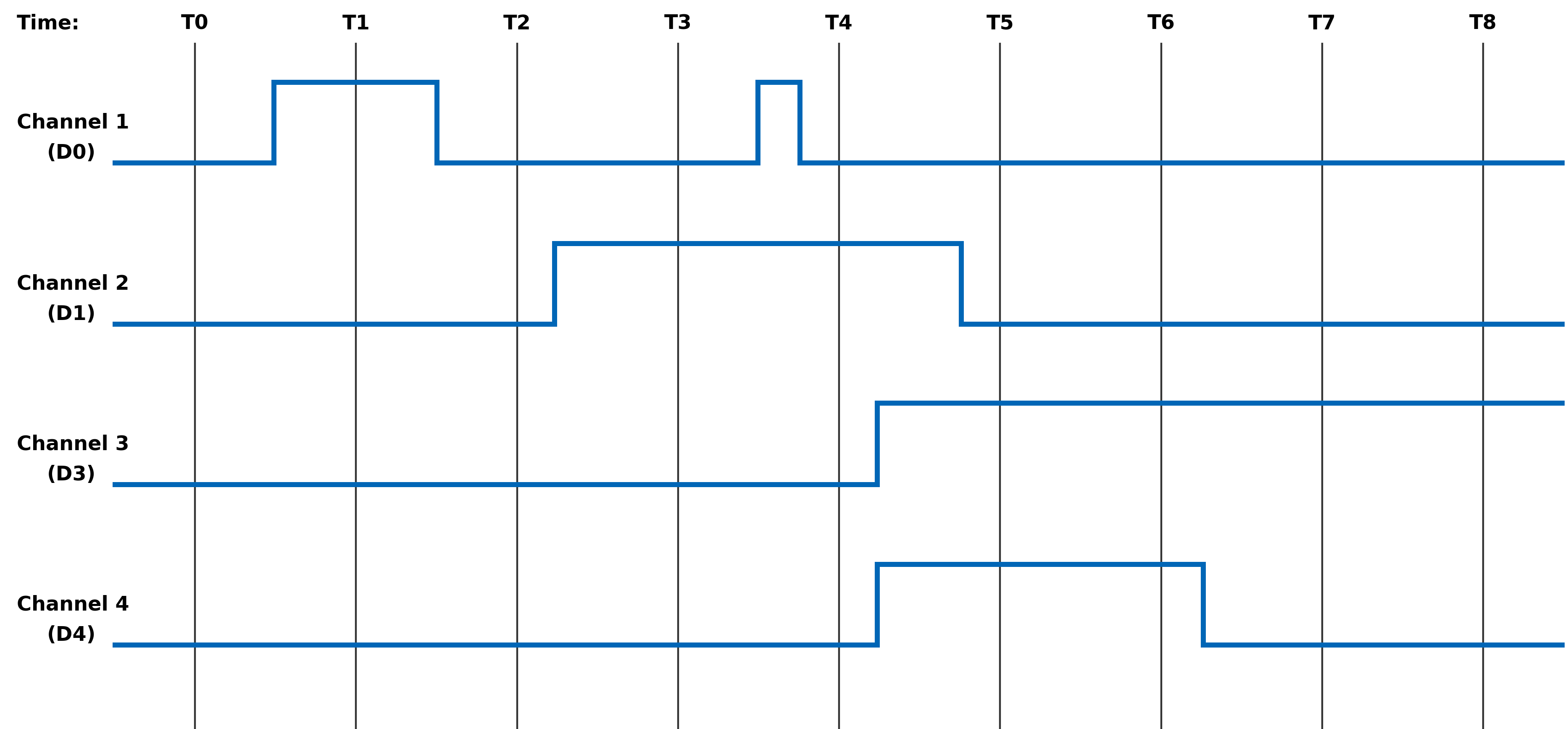
The examples in this section illustrate the differences in behavior of the Dynamic Status and Latched Status registers as well as the differences in behavior of Edge/Level Trigger when the Latched Status register is cleared.
Figure 1. Example of Module's Channel-Mapped Dynamic and Latched Status States
No Clearing of Latched Status
Clearing of Latched Status (Edge-Triggered)
Clearing of Latched Status (Level-Triggered)
Time
Dynamic Status
Latched Status
Action
Latched Status
Action
Latched
T0
0x0
0x0
Read Latched Register
0x0
Read Latched Register
0x0
T1
0x1
0x1
Read Latched Register
0x1
0x1
T1
0x1
0x1
Write 0x1 to Latched Register
Write 0x1 to Latched Register
T1
0x1
0x1
0x0
0x1
T2
0x0
0x1
Read Latched Register
0x0
Read Latched Register
0x1
T2
0x0
0x1
Read Latched Register
0x0
Write 0x1 to Latched Register
T2
0x0
0x1
Read Latched Register
0x0
0x0
T3
0x2
0x3
Read Latched Register
0x2
Read Latched Register
0x2
T3
0x2
0x3
Write 0x2 to Latched Register
Write 0x2 to Latched Register
T3
0x2
0x3
0x0
0x2
T4
0x2
0x3
Read Latched Register
0x1
Read Latched Register
0x3
T4
0x2
0x3
Write 0x1 to Latched Register
Write 0x3 to Latched Register
T4
0x2
0x3
0x0
0x2
T5
0xC
0xF
Read Latched Register
0xC
Read Latched Register
0xE
T5
0xC
0xF
Write 0xC to Latched Register
Write 0xE to Latched Register
T5
0xC
0xF
0x0
0xC
T6
0xC
0xF
Read Latched Register
0x0
Read Latched
0xC
T6
0xC
0xF
Read Latched Register
0x0
Write 0xC to Latched Register
T6
0xC
0xF
Read Latched Register
0x0
0xC
T7
0x4
0xF
Read Latched Register
0x0
Read Latched Register
0xC
T7
0x4
0xF
Read Latched Register
0x0
Write 0xC to Latched Register
T7
0x4
0xF
Read Latched Register
0x0
0x4
T8
0x4
0xF
Read Latched Register
0x0
Read Latched Register
0x4
Interrupt Examples
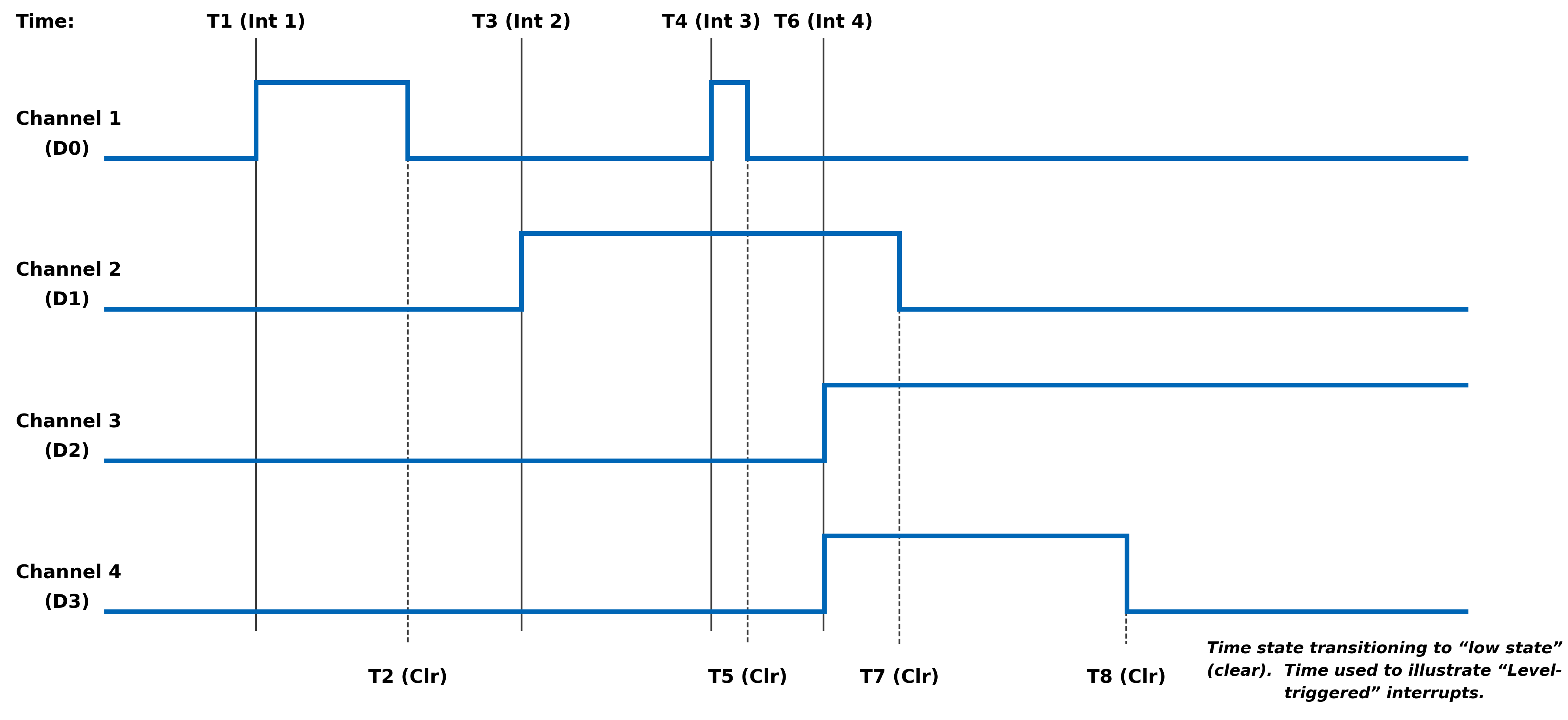
The examples in this section illustrate the interrupt behavior with Edge/Level Trigger.
Figure 2. Illustration of Latched Status State for Module with 4-Channels with Interrupt Enabled
Time
Latched Status (Edge-Triggered - Clear Multi-Channel)
Latched Status (Edge-Triggered - Clear Single Channel)
Latched Status (Level-Triggered - Clear Multi-Channel)
Action
Latched
Action
Latched
Action
Latched
T1 (Int 1)
Interrupt Generated Read Latched Registers
0x1
Interrupt Generated Read Latched Registers
0x1
Interrupt Generated Read Latched Registers
0x1
T1 (Int 1)
Write 0x1 to Latched Register
Write 0x1 to Latched Register
Write 0x1 to Latched Register
T1 (Int 1)
0x0
0x0
Interrupt re-triggers Note, interrupt re-triggers after each clear until T2.
0x1
T3 (Int 2)
Interrupt Generated Read Latched Registers
0x2
Interrupt Generated Read Latched Registers
0x2
Interrupt Generated Read Latched Registers
0x2
T3 (Int 2)
Write 0x2 to Latched Register
Write 0x2 to Latched Register
Write 0x2 to Latched Register
T3 (Int 2)
0x0
0x0
Interrupt re-triggers Note, interrupt re-triggers after each clear until T7.
0x2
T4 (Int 3)
Interrupt Generated Read Latched Registers
0x1
Interrupt Generated Read Latched Registers
0x1
Interrupt Generated Read Latched Registers
0x3
T4 (Int 3)
Write 0x1 to Latched Register
Write 0x1 to Latched Register
Write 0x3 to Latched Register
T4 (Int 3)
0x0
0x0
Interrupt re-triggers Note, interrupt re-triggers after each clear and 0x3 is reported in Latched Register until T5.
0x3
T4 (Int 3)
0x0
0x0
Interrupt re-triggers Note, interrupt re-triggers after each clear until T7.
0x2
T6 (Int 4)
Interrupt Generated Read Latched Registers
0xC
Interrupt Generated Read Latched Registers
0xC
Interrupt Generated Read Latched Registers
0xE
T6 (Int 4)
Write 0xC to Latched Register
Write 0x4 to Latched Register
Write 0xE to Latched Register
T6 (Int 4)
0x0
Interrupt re-triggers Write 0x8 to Latched Register
0x8
Interrupt re-triggers Note, interrupt re-triggers after each clear and 0xE is reported in Latched Register until T7.
0xE
T6 (Int 4)
0x0
0x0
Interrupt re-triggers Note, interrupt re-triggers after each clear and 0xC is reported in Latched Register until T8.
0xC
T6 (Int 4)
0x0
0x0
Interrupt re-triggers Note, interrupt re-triggers after each clear and 0x4 is reported in Latched Register always.
0x4
REVISION HISTORY
Motherboard Manual - Status and Interrupts Revision History
Revision
Revision Date
Description
C
2021-11-30
C08896; Transition manual to docbuilder format - no technical info change.
DOCS.NAII REVISIONS
Revision Date
Description
2026-03-02
Formatting updates to document; no technical changes.
2026-05-18
Fixed formatting issues from conversion to new doc site format.
2026-05-19
Fixed minor formatting issue with Interrupt Examples table structure (removed extraneous cell).
The registers described in this document are common to all NAI Generation 5 modules.
Module Information Registers
The registers in this section provide module information such as firmware revisions, capabilities and unique serial number information.
FPGA Version Registers
The FPGA firmware version registers include registers that contain the Revision, Compile Timestamp, SerDes Revision, Template Revision and Zynq Block Revision information.
FPGA Revision
Function:
FPGA firmware revision
Type:
unsigned binary word (32-bit)
Data Range:
0x0000 0000 to 0xFFFF FFFF
Read/Write:
R
Initialized Value:
Value corresponding to the revision of the board's FPGA
Operational Settings:
The upper 16-bits are the major revision and the lower 16-bits are the minor revision.
D31
D30
D29
D28
D27
D26
D25
D24
D23
D22
D21
D20
D19
D18
D17
D16
Major Revision Number
D15
D14
D13
D12
D11
D10
D9
D8
D7
D6
D5
D4
D3
D2
D1
D0
Minor Revision Number
FPGA Compile Timestamp
Function:
Compile Timestamp for the FPGA firmware.
Type:
unsigned binary word (32-bit)
Data Range:
N/A
Read/Write:
R
Initialized Value:
Value corresponding to the compile timestamp of the board's FPGA
Operational Settings:
The 32-bit value represents the Day, Month, Year, Hour, Minutes and Seconds as formatted in the table:
D31
D30
D29
D28
D27
D26
D25
D24
D23
D22
D21
D20
D19
D18
D17
D16
day (5-bits)
month (4-bits)
year (6-bits)
hr
D15
D14
D13
D12
D11
D10
D9
D8
D7
D6
D5
D4
D3
D2
D1
D0
hour (5-bits)
minutes (6-bits)
seconds (6-bits)
FPGA SerDes Revision
Function:
FPGA SerDes revision
Type:
unsigned binary word (32-bit)
Data Range:
0x0000 0000 to 0xFFFF FFFF
Read/Write:
R
Initialized Value:
Value corresponding to the SerDes revision of the board's FPGA
Operational Settings:
The upper 16-bits are the major revision, and the lower 16-bits are the minor revision.
D31
D30
D29
D28
D27
D26
D25
D24
D23
D22
D21
D20
D19
D18
D17
D16
Major Revision Number
D15
D14
D13
D12
D11
D10
D9
D8
D7
D6
D5
D4
D3
D2
D1
D0
Minor Revision Number
FPGA Template Revision
Function:
FPGA Template revision
Type:
unsigned binary word (32-bit)
Data Range:
0x0000 0000 to 0xFFFF FFFF
Read/Write:
R
Initialized Value:
Value corresponding to the template revision of the board's FPGA
Operational Settings:
The upper 16-bits are the major revision, and the lower 16-bits are the minor revision.
D31
D30
D29
D28
D27
D26
D25
D24
D23
D22
D21
D20
D19
D18
D17
D16
Major Revision Number
D15
D14
D13
D12
D11
D10
D9
D8
D7
D6
D5
D4
D3
D2
D1
D0
Minor Revision Number
FPGA Zynq Block Revision
Function:
FPGA Zynq Block revision
Type:
unsigned binary word (32-bit)
Data Range:
0x0000 0000 to 0xFFFF FFFF
Read/Write:
R
Initialized Value:
Value corresponding to the Zynq block revision of the board's FPGA
Operational Settings:
The upper 16-bits are the major revision, and the lower 16-bits are the minor revision.
D31
D30
D29
D28
D27
D26
D25
D24
D23
D22
D21
D20
D19
D18
D17
D16
Major Revision Number
D15
D14
D13
D12
D11
D10
D9
D8
D7
D6
D5
D4
D3
D2
D1
D0
Minor Revision Number
Bare Metal Version Registers
The Bare Metal firmware version registers include registers that contain the Revision and Compile Time information.
Bare Metal Revision
Function:
Bare Metal firmware revision
Type:
unsigned binary word (32-bit)
Data Range:
0x0000 0000 to 0xFFFF FFFF
Read/Write:
R
Initialized Value:
Value corresponding to the revision of the board's Bare Metal
Operational Settings:
The upper 16-bits are the major revision and the lower 16-bits are the minor revision.
D31
D30
D29
D28
D27
D26
D25
D24
D23
D22
D21
D20
D19
D18
D17
D16
Major Revision Number
D15
D14
D13
D12
D11
D10
D9
D8
D7
D6
D5
D4
D3
D2
D1
D0
Minor Revision Number
Bare Metal Compile Time
Function:
Provides an ASCII representation of the Date/Time for the Bare Metal compile time.
Type:
24-character ASCII string - Six (6) unsigned binary word (32-bit)
Data Range:
N/A
Read/Write:
R
Initialized Value:
Value corresponding to the ASCII representation of the compile time of the board's Bare Metal
Operational Settings:
The six 32-bit words provide an ASCII representation of the Date/Time. The hexadecimal values in the field below represent: May 17 2019 at 15:38:32
Note
little-endian order of ASCII values
Word 1 (Ex. 0x2079614D)
D31
D30
D29
D28
D27
D26
D25
D24
D23
D22
D21
D20
D19
D18
D17
D16
Space (0x20)
Month ('y' - 0x79)
D15
D14
D13
D12
D11
D10
D9
D8
D7
D6
D5
D4
D3
D2
D1
D0
Month ('a' - 0x61)
Month ('M' - 0x4D)
Word 2 (Ex. 0x32203731)
D31
D30
D29
D28
D27
D26
D25
D24
D23
D22
D21
D20
D19
D18
D17
D16
Year ('2' - 0x32)
Space (0x20)
D15
D14
D13
D12
D11
D10
D9
D8
D7
D6
D5
D4
D3
D2
D1
D0
Day ('7' - 0x37)
Day ('1' - 0x31)
Word 3 (Ex. 0x20393130)
D31
D30
D29
D28
D27
D26
D25
D24
D23
D22
D21
D20
D19
D18
D17
D16
Space (0x20)
Year ('9' - 0x39)
D15
D14
D13
D12
D11
D10
D9
D8
D7
D6
D5
D4
D3
D2
D1
D0
Year ('1' - 0x31)
Year ('0' - 0x30)
Word 4 (Ex. 0x31207461)
D31
D30
D29
D28
D27
D26
D25
D24
D23
D22
D21
D20
D19
D18
D17
D16
Hour ('1' - 0x31)
Space (0x20)
D15
D14
D13
D12
D11
D10
D9
D8
D7
D6
D5
D4
D3
D2
D1
D0
'a' (0x74)
't' (0x61)
Word 5 (Ex. 0x38333A35)
D31
D30
D29
D28
D27
D26
D25
D24
D23
D22
D21
D20
D19
D18
D17
D16
Minute ('8' - 0x38)
Minute ('3' - 0x33)
D15
D14
D13
D12
D11
D10
D9
D8
D7
D6
D5
D4
D3
D2
D1
D0
':' (0x3A)
Hour ('5' - 0x35)
Word 6 (Ex. 0x0032333A)
D31
D30
D29
D28
D27
D26
D25
D24
D23
D22
D21
D20
D19
D18
D17
D16
NULL (0x00)
Seconds ('2' - 0x32)
D15
D14
D13
D12
D11
D10
D9
D8
D7
D6
D5
D4
D3
D2
D1
D0
Seconds ('3' - 0x33)
':' (0x3A)
FSBL Version Registers
The FSBL version registers include registers that contain the Revision and Compile Time information for the First Stage Boot Loader (FSBL).
FSBL Revision
Function:
FSBL firmware revision
Type:
unsigned binary word (32-bit)
Data Range:
0x0000 0000 to 0xFFFF FFFF
Read/Write:
R
Initialized Value:
Value corresponding to the revision of the board's FSBL
Operational Settings:
The upper 16-bits are the major revision, and the lower 16-bits are the minor revision.
D31
D30
D29
D28
D27
D26
D25
D24
D23
D22
D21
D20
D19
D18
D17
D16
Major Revision Number
D15
D14
D13
D12
D11
D10
D9
D8
D7
D6
D5
D4
D3
D2
D1
D0
Minor Revision Number
FSBL Compile Time
Function:
Provides an ASCII representation of the Date/Time for the FSBL compile time.
Type:
24-character ASCII string - Six (6) unsigned binary word (32-bit)
Data Range:
N/A
Read/Write:
R
Initialized Value:
Value corresponding to the ASCII representation of the Compile Time of the board's FSBL
Operational Settings:
The six 32-bit words provide an ASCII representation of the Date/Time.
The hexadecimal values in the field below represent: May 17 2019 at 15:38:32
Note
little-endian order of ASCII values
Word 1 (Ex. 0x2079614D)
D31
D30
D29
D28
D27
D26
D25
D24
D23
D22
D21
D20
D19
D18
D17
D16
Space (0x20)
Month ('y' - 0x79)
D15
D14
D13
D12
D11
D10
D9
D8
D7
D6
D5
D4
D3
D2
D1
D0
Month ('a' - 0x61)
Month ('M' - 0x4D)
Word 2 (Ex. 0x32203731)
D31
D30
D29
D28
D27
D26
D25
D24
D23
D22
D21
D20
D19
D18
D17
D16
Year ('2' - 0x32)
Space (0x20)
D15
D14
D13
D12
D11
D10
D9
D8
D7
D6
D5
D4
D3
D2
D1
D0
Day ('7' - 0x37)
Day ('1' - 0x31)
Word 3 (Ex. 0x20393130)
D31
D30
D29
D28
D27
D26
D25
D24
D23
D22
D21
D20
D19
D18
D17
D16
Space (0x20)
Year ('9' - 0x39)
D15
D14
D13
D12
D11
D10
D9
D8
D7
D6
D5
D4
D3
D2
D1
D0
Year ('1' - 0x31)
Year ('0' - 0x30)
Word 4 (Ex. 0x31207461)
D31
D30
D29
D28
D27
D26
D25
D24
D23
D22
D21
D20
D19
D18
D17
D16
Hour ('1' - 0x31)
Space (0x20)
D15
D14
D13
D12
D11
D10
D9
D8
D7
D6
D5
D4
D3
D2
D1
D0
'a' (0x74)
't' (0x61)
Word 5 (Ex. 0x38333A35)
D31
D30
D29
D28
D27
D26
D25
D24
D23
D22
D21
D20
D19
D18
D17
D16
Minute ('8' - 0x38)
Minute ('3' - 0x33)
D15
D14
D13
D12
D11
D10
D9
D8
D7
D6
D5
D4
D3
D2
D1
D0
':' (0x3A)
Hour ('5' - 0x35)
Word 6 (Ex. 0x0032333A)
D31
D30
D29
D28
D27
D26
D25
D24
D23
D22
D21
D20
D19
D18
D17
D16
NULL (0x00)
Seconds ('2' - 0x32)
D15
D14
D13
D12
D11
D10
D9
D8
D7
D6
D5
D4
D3
D2
D1
D0
Seconds ('3' - 0x33)
':' (0x3A)
Module Serial Number Registers
The Module Serial Number registers include registers that contain the Serial Numbers for the Interface Board and the Functional Board of the module.
Interface Board Serial Number
Function:
Unique 128-bit identifier used to identify the interface board.
Type:
16-character ASCII string - Four (4) unsigned binary words (32-bit)
Data Range:
N/A
Read/Write:
R
Initialized Value:
Serial number of the interface board
Operational Settings:
This register is for information purposes only.
Functional Board Serial Number
Function:
Unique 128-bit identifier used to identify the functional board.
Type:
16-character ASCII string - Four (4) unsigned binary words (32-bit)
Data Range:
N/A
Read/Write:
R
Initialized Value:
Serial number of the functional board
Operational Settings:
This register is for information purposes only.
Module Capability
Function:
Provides indication for whether or not the module can support the following: SerDes block reads, SerDes FIFO block reads, SerDes packing (combining two 16-bit values into one 32-bit value) and floating point representation. The purpose for block access and packing is to improve the performance of accessing larger amounts of data over the SerDes interface.
Type:
unsigned binary word (32-bit)
Data Range:
0x0000 0000 to 0x0000 0107
Read/Write:
R
Initialized Value:
0x0000 0107
Operational Settings:
A “1” in the bit associated with the capability indicates that it is supported.
D31
D30
D29
D28
D27
D26
D25
D24
D23
D22
D21
D20
D19
D18
D17
D16
0
0
0
0
0
0
0
0
0
0
0
0
0
0
0
0
D15
D14
D13
D12
D11
D10
D9
D8
D7
D6
D5
D4
D3
D2
D1
D0
0
0
0
0
0
0
0
Flt-Pt
0
0
0
0
0
Pack
FIFO Blk
Blk
Module Memory Map Revision
Function:
Module Memory Map revision
Type:
unsigned binary word (32-bit)
Data Range:
0x0000 0000 to 0xFFFF FFFF
Read/Write:
R
Initialized Value:
Value corresponding to the Module Memory Map Revision
Operational Settings:
The upper 16-bits are the major revision and the lower 16-bits are the minor revision.
D31
D30
D29
D28
D27
D26
D25
D24
D23
D22
D21
D20
D19
D18
D17
D16
Major Revision Number
D15
D14
D13
D12
D11
D10
D9
D8
D7
D6
D5
D4
D3
D2
D1
D0
Minor Revision Number
Module Measurement Registers
The registers in this section provide module temperature measurement information.
Temperature Readings Registers
The temperature registers provide the current, maximum (from power-up) and minimum (from power-up) Zynq and PCB temperatures.
Interface Board Current Temperature
Function:
Measured PCB and Zynq Core temperatures on Interface Board.
Type:
signed byte (8-bits) for PCB and signed byte (8-bits) for Zynq core temperatures
Data Range:
0x0000 0000 to 0x0000 FFFF
Read/Write:
R
Initialized Value:
Value corresponding to the measured PCB and Zynq core temperatures based on the table below
Operational Settings:
The upper 16-bits are not used, and the lower 16-bits are the PCB and Zynq Core Temperatures. For example, if the register contains the value 0x0000 202C, this represents PCB Temperature = 32° Celsius and Zynq Temperature = 44° Celsius.
D31
D30
D29
D28
D27
D26
D25
D24
D23
D22
D21
D20
D19
D18
D17
D16
0
0
0
0
0
0
0
0
0
0
0
0
0
0
0
0
D15
D14
D13
D12
D11
D10
D9
D8
D7
D6
D5
D4
D3
D2
D1
D0
PCB Temperature
Zynq Core Temperature
Functional Board Current Temperature
Function:
Measured PCB temperature on Functional Board.
Type:
signed byte (8-bits) for PCB
Data Range:
0x0000 0000 to 0x0000 00FF
Read/Write:
R
Initialized Value:
Value corresponding to the measured PCB on the table below
Operational Settings:
The upper 24-bits are not used, and the lower 8-bits are the PCB Temperature. For example, if the register contains the value 0x0000 0019, this represents PCB Temperature = 25° Celsius.
D31
D30
D29
D28
D27
D26
D25
D24
D23
D22
D21
D20
D19
D18
D17
D16
0
0
0
0
0
0
0
0
0
0
0
0
0
0
0
0
D15
D14
D13
D12
D11
D10
D9
D8
D7
D6
D5
D4
D3
D2
D1
D0
0
0
0
0
0
0
0
0
PCB Temperature
Interface Board Maximum Temperature
Function:
Maximum PCB and Zynq Core temperatures on Interface Board since power-on.
Type:
signed byte (8-bits) for PCB and signed byte (8-bits) for Zynq core temperatures
Data Range:
0x0000 0000 to 0x0000 FFFF
Read/Write:
R
Initialized Value:
Value corresponding to the maximum measured PCB and Zynq core temperatures since power-on based on the table below
Operational Settings:
The upper 16-bits are not used, and the lower 16-bits are the maximum PCB and Zynq Core Temperatures. For example, if the register contains the value 0x0000 5569, this represents maximum PCB Temperature = 85° Celsius and maximum Zynq Temperature = 105° Celsius.
D31
D30
D29
D28
D27
D26
D25
D24
D23
D22
D21
D20
D19
D18
D17
D16
0
0
0
0
0
0
0
0
0
0
0
0
0
0
0
0
D15
D14
D13
D12
D11
D10
D9
D8
D7
D6
D5
D4
D3
D2
D1
D0
PCB Temperature
Zynq Core Temperature
Interface Board Minimum Temperature
Function:
Minimum PCB and Zynq Core temperatures on Interface Board since power-on.
Type:
signed byte (8-bits) for PCB and signed byte (8-bits) for Zynq core temperatures
Data Range:
0x0000 0000 to 0x0000 FFFF
Read/Write:
R
Initialized Value:
Value corresponding to the minimum measured PCB and Zynq core temperatures since power-on based on the table below
Operational Settings:
The upper 16-bits are not used, and the lower 16-bits are the minimum PCB and Zynq Core Temperatures. For example, if the register contains the value 0x0000 D8E7, this represents minimum PCB Temperature = -40° Celsius and minimum Zynq Temperature = -25° Celsius.
D31
D30
D29
D28
D27
D26
D25
D24
D23
D22
D21
D20
D19
D18
D17
D16
0
0
0
0
0
0
0
0
0
0
0
0
0
0
0
0
D15
D14
D13
D12
D11
D10
D9
D8
D7
D6
D5
D4
D3
D2
D1
D0
PCB Temperature
Zynq Core Temperature
Functional Board Maximum Temperature
Function:
Maximum PCB temperature on Functional Board since power-on.
Type:
signed byte (8-bits) for PCB
Data Range:
0x0000 0000 to 0x0000 00FF
Read/Write:
R
Initialized Value:
Value corresponding to the measured PCB on the table below
Operational Settings:
The upper 24-bits are not used, and the lower 8-bits are the PCB Temperature. For example, if the register contains the value 0x0000 0055, this represents PCB Temperature = 85° Celsius.
D31
D30
D29
D28
D27
D26
D25
D24
D23
D22
D21
D20
D19
D18
D17
D16
0
0
0
0
0
0
0
0
0
0
0
0
0
0
0
0
D15
D14
D13
D12
D11
D10
D9
D8
D7
D6
D5
D4
D3
D2
D1
D0
0
0
0
0
0
0
0
0
PCB Temperature
Functional Board Minimum Temperature
Function:
Minimum PCB temperature on Functional Board since power-on.
Type:
signed byte (8-bits) for PCB
Data Range:
0x0000 0000 to 0x0000 00FF
Read/Write:
R
Initialized Value:
Value corresponding to the measured PCB on the table below
Operational Settings:
The upper 24-bits are not used, and the lower 8-bits are the PCB Temperature. For example, if the register contains the value 0x0000 00D8, this represents PCB Temperature = -40° Celsius.
D31
D30
D29
D28
D27
D26
D25
D24
D23
D22
D21
D20
D19
D18
D17
D16
0
0
0
0
0
0
0
0
0
0
0
0
0
0
0
0
D15
D14
D13
D12
D11
D10
D9
D8
D7
D6
D5
D4
D3
D2
D1
D0
0
0
0
0
0
0
0
0
PCB Temperature
Higher Precision Temperature Readings Registers
These registers provide higher precision readings of the current Zynq and PCB temperatures.
Higher Precision Zynq Core Temperature
Function:
Higher precision measured Zynq Core temperature on Interface Board.
Type:
signed word (16-bits) for integer part and unsigned word (16-bits) for fractional part
Data Range:
0x0000 0000 to 0xFFFF FFFF
Read/Write:
R
Initialized Value:
Measured Zynq Core temperature on Interface Board
Operational Settings:
The upper 16-bits represent the signed integer part of the temperature and the lower 16-bits represent the fractional part of the temperature with the resolution of 1/1000 of degree Celsius. For example, if the register contains the value 0x002B 0271, this represents Zynq Core Temperature = 43.625° Celsius, and value 0xFFF6 0177 represents -10.375° Celsius.
signed word (16-bits) for integer part and unsigned word (16-bits) for fractional part
Data Range:
0x0000 0000 to 0xFFFF FFFF
Read/Write:
R
Initialized Value:
Measured Interface PCB temperature
Operational Settings:
The upper 16-bits represent the signed integer part of the temperature and the lower 16-bits represent the fractional part of the temperature with the resolution of 1/1000 of degree Celsius. For example, if the register contains the value 0x0020 007D, this represents Interface PCB Temperature = 32.125° Celsius, and value 0xFFE8 036B represents -24.875° Celsius.
signed word (16-bits) for integer part and unsigned word (16-bits) for fractional part
Data Range:
0x0000 0000 to 0xFFFF FFFF
Read/Write:
R
Initialized Value:
Measured Functional PCB temperature
Operational Settings:
The upper 16-bits represent the signed integer part of the temperature and the lower 16-bits represent the fractional part of the temperature with the resolution of 1/100 of degree Celsius. For example, if the register contains the value 0x0018 004B, this represents Functional PCB Temperature = 24.75° Celsius, and value 0xFFD9 0019 represents -39.25° Celsius.
D31
D30
D29
D28
D27
D26
D25
D24
D23
D22
D21
D20
D19
D18
D17
D16
Signed Integer Part of Temperature
D15
D14
D13
D12
D11
D10
D9
D8
D7
D6
D5
D4
D3
D2
D1
D0
Fractional Part of Temperature
Module Health Monitoring Registers
The registers in this section provide module temperature measurement information. If the temperature measurements reaches the Lower Critical or Upper Critical conditions, the module will automatically reset itself to prevent damage to the hardware.
Module Sensor Summary Status
Function:
The corresponding sensor bit is set if the sensor has crossed any of its thresholds.
Type:
unsigned binary word (32-bits)
Data Range:
See table below
Read/Write:
R
Initialized Value:
0
Operational Settings:
This register provides a summary for module sensors. When the corresponding sensor bit is set, the Sensor Threshold Status register for that sensor will indicate the threshold condition that triggered the event.
Bit(s)
Sensor
D31:D6
Reserved
D5
Functional Board PCB Temperature
D4
Interface Board PCB Temperature
D3:D0
Reserved
Module Sensor Registers
The registers listed in this section apply to each module sensor listed for the Module Sensor Summary Status register. Each individual sensor register provides a group of registers for monitoring module temperatures readings. From these registers, a user can read the current temperature of the sensor in addition to the minimum and maximum temperature readings since power-up. Upper and lower critical/warning temperature thresholds can be set and monitored from these registers. When a programmed temperature threshold is crossed, the Sensor Threshold Status register will set the corresponding bit for that threshold. The figure below shows the functionality of this group of registers when accessing the Interface Board PCB Temperature sensor as an example.
Sensor Threshold Status
Function:
Reflects which threshold has been crossed
Type:
unsigned binary word (32-bits)
Data Range:
See table below
Read/Write:
R
Initialized Value:
0
Operational Settings:
The associated bit is set when the sensor reading exceed the corresponding threshold settings.
Bit(s)
Description
D31:D4
Reserved
D3
Exceeded Upper Critical Threshold
D2
Exceeded Upper Warning Threshold
D1
Exceeded Lower Critical Threshold
D0
Exceeded Lower Warning Threshold
Sensor Current Reading
Function:
Reflects current reading of temperature sensor
Type:
Single Precision Floating Point Value (IEEE-754)
Data Range:
Single Precision Floating Point Value (IEEE-754)
Read/Write:
R
Initialized Value:
N/A
Operational Settings:
The register represents current sensor reading as a single precision floating point value. For example, for a temperature sensor, register value 0x41C6 0000 represents temperature = 24.75° Celsius.
Sensor Minimum Reading
Function:
Reflects minimum value of temperature sensor since power up
Type:
Single Precision Floating Point Value (IEEE-754)
Data Range:
Single Precision Floating Point Value (IEEE-754)
Read/Write:
R
Initialized Value:
N/A
Operational Settings:
The register represents minimum sensor value as a single precision floating point value. For example, for a temperature sensor, register value 0x41C6 0000 represents temperature = 24.75° Celsius.
Sensor Maximum Reading
Function:
Reflects maximum value of temperature sensor since power up
Type:
Single Precision Floating Point Value (IEEE-754)
Data Range:
Single Precision Floating Point Value (IEEE-754)
Read/Write:
R
Initialized Value:
N/A
Operational Settings:
The register represents maximum sensor value as a single precision floating point value. For example, for a temperature sensor, register value 0x41C6 0000 represents temperature = 24.75° Celsius.
Sensor Lower Warning Threshold
Function:
Reflects lower warning threshold of temperature sensor
Type:
Single Precision Floating Point Value (IEEE-754)
Data Range:
Single Precision Floating Point Value (IEEE-754)
Read/Write:
R/W
Initialized Value:
Default lower warning threshold (value dependent on specific sensor)
Operational Settings:
The register represents sensor lower warning threshold as a single precision floating point value. For example, for a temperature sensor, register value 0xC220 0000 represents temperature = -40.0° Celsius.
Sensor Lower Critical Threshold
Function:
Reflects lower critical threshold of temperature sensor
Type:
Single Precision Floating Point Value (IEEE-754)
Data Range:
Single Precision Floating Point Value (IEEE-754)
Read/Write:
R/W
Initialized Value:
Default lower critical threshold (value dependent on specific sensor)
Operational Settings:
The register represents sensor lower critical threshold as a single precision floating point value. For example, for a temperature sensor, register value 0xC25C 0000 represents temperature = -55.0° Celsius.
Sensor Upper Warning Threshold
Function:
Reflects upper warning threshold of temperature sensor
Type:
Single Precision Floating Point Value (IEEE-754)
Data Range:
Single Precision Floating Point Value (IEEE-754)
Read/Write:
R/W
Initialized Value:
Default upper warning threshold (value dependent on specific sensor)
Operational Settings:
The register represents sensor upper warning threshold as a single precision floating point value. For example, for a temperature sensor, register value 0x42AA 0000 represents temperature = 85.0° Celsius.
Sensor Upper Critical Threshold
Function:
Reflects upper critical threshold of temperature sensor
Type:
Single Precision Floating Point Value (IEEE-754)
Data Range:
Single Precision Floating Point Value (IEEE-754)
Read/Write:
R/W
Initialized Value:
Default upper critical threshold (value dependent on specific sensor)
Operational Settings:
The register represents sensor upper critical threshold as a single precision floating point value. For example, for a temperature sensor, register value 0x42FA 0000 represents temperature = 125.0° Celsius.
FUNCTION REGISTER MAP
KEY
Configuration/Control
Measurement/Status/Board Information
MODULE INFORMATION REGISTERS
OFFSET
REGISTER NAME
ACCESS
OFFSET
REGISTER NAME
ACCESS
0x003C
FPGA Revision
R
0x0074
Bare Metal Revision
R
0x0030
FPGA Compile Timestamp
R
0x0080
Bare Metal Compile Time (Bit 0-31)
R
0x0034
FPGA SerDes Revision
R
0x0084
Bare Metal Compile Time (Bit 32-63)
R
0x0038
FPGA Template Revision
R
0x0088
Bare Metal Compile Time (Bit 64-95)
R
0x0040
FPGA Zynq Block Revision
R
0x008C
Bare Metal Compile Time (Bit 96-127)
R
0x0090
Bare Metal Compile Time (Bit 128-159)
R
0x0094
Bare Metal Compile Time (Bit 160-191)
R
0x007C
FSBL Revision
R
0x00B0
FSBL Compile Time (Bit 0-31)
R
0x00B4
FSBL Compile Time (Bit 32-63)
R
0x00B8
FSBL Compile Time (Bit 64-95)
R
0x00BC
FSBL Compile Time (Bit 96-127)
R
0x00C0
FSBL Compile Time (Bit 128-159)
R
0x00C4
FSBL Compile Time (Bit 160-191)
R
0x0000
Interface Board Serial Number (Bit 0-31)
R
0x0010
Functional Board Serial Number (Bit 0-31)
R
0x0034
Interface Board Serial Number (Bit 32-63)
R
0x0014
Functional Board Serial Number (Bit 32-63)
R
0x0008
Interface Board Serial Number (Bit 64-95)
R
0x0018
Functional Board Serial Number (Bit 64-95)
R
0x000C
Interface Board Serial Number (Bit 96-127)
R
0x001C
Functional Board Serial Number (Bit 96-127)
R
0x0070
Module Capability
R
0x01FC
Module Memory Map Revision
R
MODULE MEASUREMENTS REGISTERS
OFFSET
REGISTER NAME
ACCESS
OFFSET
REGISTER NAME
ACCESS
0x0200
Interface Board PCB/Zynq Current Temp
R
0x0208
Functional Board PCB Current Temp
R
0x0218
Interface Board PCB/Zynq Max Temp
R
0x0228
Functional Board PCB Max Temp
R
0x0220
Interface Board PCB/Zynq Min Temp
R
0x0230
Functional Board PCB Min Temp
R
0x02C0
Higher Precision Zynq Core Temperature
R
0x02C4
Higher Precision Interface PCB Temperature
R
0x02E0
Higher Precision Functional PCB Temperature
R
MODULE HEALTH MONITORING REGISTERS
OFFSET
REGISTER NAME
ACCESS
OFFSET
REGISTER NAME
ACCESS
0x07F8
Module Sensor Summary Status
R
REVISION HISTORY
Motherboard Manual - Module Common Registers Revision History
Revision
Revision Date
Description
C
2023-08-11
ECO C10649, initial release of module common registers manual.
C1
2024-05-15
ECO C11522, removed Zynq Core/Aux/DDR Voltage register descriptions from Module Measurement Registers. Pg.16, updated Module Sensor Summary Status register to add PS references; updated Bit Table to change voltage/current bits to 'reserved'. Pg.16, updated Module/Power Supply Sensor Registers description to better describe register functionality and to add figure. Pg.17, added 'Exceeded' to threshold bit descriptions. Pg.17-18, removed voltage/current references from sensor descriptions. Pg.20, removed Zynq Core/Aux/DDR Voltage register offsets from Module Measurement Registers. Pg.20, updated Module Health Monitoring Registers offset tables.
C2
2024-07-10
ECO C11701, pg.16, updated Module Sensor Summary Status register to remove PS references;updated Bit Table to change PS temperature bits to 'reserved'. Pg.16, updated Module SensorRegisters description to remove PS references. Pg.20, updated Module Health MonitoringRegisters offset tables to remove PS temperature register offsets.
DOCS.NAII REVISIONS
Revision Date
Description
2025-11-05
Corrected register offsets for Interface Board Min Temp and Function Board Min & Max Temps.
2026-03-02
Formatting updates to document; no technical changes.
2026-05-20
Minor formatting fixes (non-technical changes).
2026-07-15
Updated images for online quality; minor additional formatting updates (no technical changes).
North Atlantic Industries (NAI) is a leading independent supplier of Embedded I/O Boards, Single Board Computers, Rugged Power Supplies, Embedded Systems and Motion Simulation and Measurement Instruments for the Military, Aerospace and Industrial Industries. We accelerate our clients’ time-to-mission with a unique approach based on a Configurable Open Systems Architecture™ (COSA®) that delivers the best of both worlds: custom solutions from standard COTS components.
We have built a reputation by listening to our customers, understanding their needs, and designing, testing and delivering board and system-level products for their most demanding air, land and sea requirements. If you have any applications or questions regarding the use of our products, please contact us for an expedient solution.
Please visit us at: www.naii.com or select one of the following for immediate assistance: