
When making ripple measurements on switching power supplies, it is important to use high frequency differential equipment. This is required because the scope probe ground lead will act as an antenna. This will make small amounts of common mode noise appear as large amounts of differential noise.
Although the NAI power supply group does use high frequency differential equipment in our final test setups, it is not typical to find such equipment at many test and design labs due to the high cost and low demand for this type of measurement. An alternate method may be used for accurate measurements, but it should be noted that this method requires that the safety ground of the scope be removed (this is also called floating the scope). This is typically not recommended because if the scope has an internal short to the chassis or to the probe return, a safety hazard will exist. The scope can be powered through an isolation transformer if this is a concern, or better yet an ungrounded battery operated scope will have no safety concern.
The next step after floating the scope will be to use only the tip and barrel of the probe to make the measurement. This is shown in the photo below.
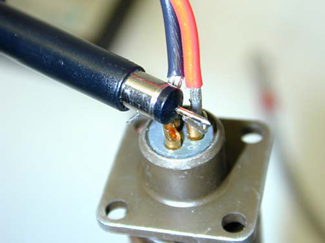
Tip-and-barrel measurement: the probe tip contacts one pin of the output pair and the probe barrel contacts the other, directly at the connector, with no ground lead.
This guarantees minimal length of the leads. One should also ensure the measurement is as close to the interface connector as possible.